
The Wonderful Atmosphere
Earth & Planet · Interactive
- DimensionsSubject to on-site plan
- PresentationInteractive
- PricingQuoted by manufacture spec
Purpose & Scientific Principle
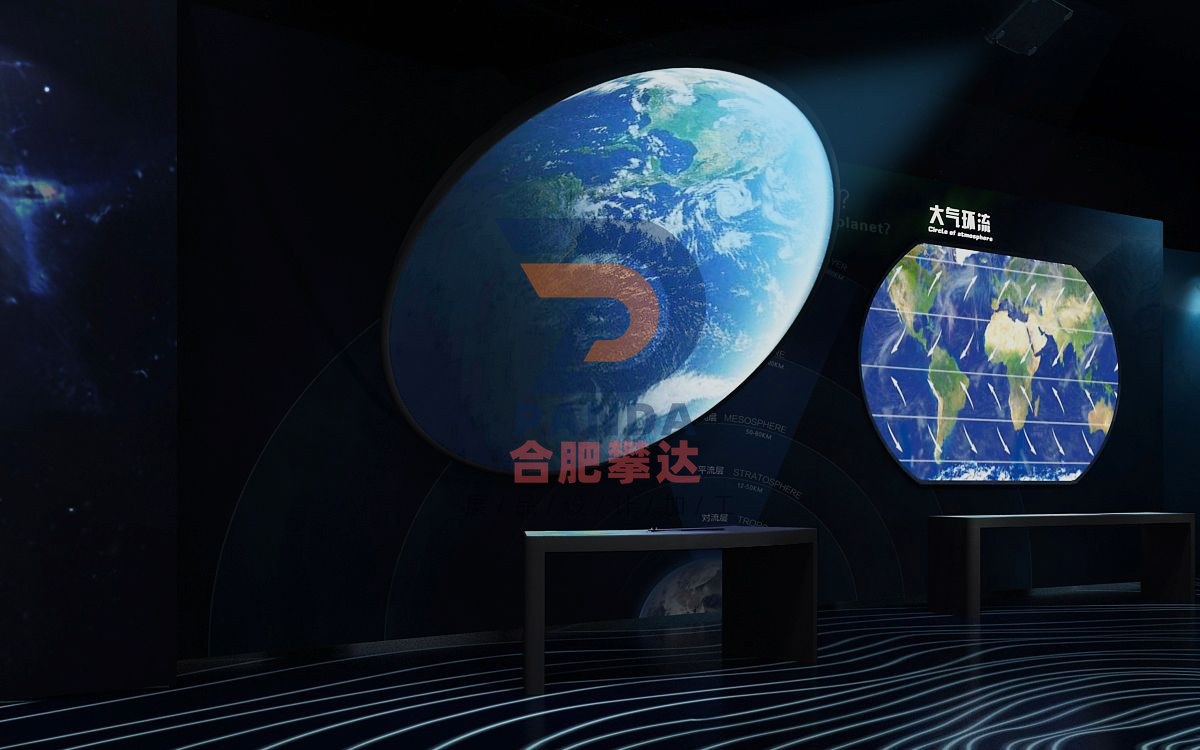
This exhibit combines multimedia dome projection with the audience's interactive operation experience to allow the audience to understand the formation, vertical structure and importance of the earth's atmosphere to the existence of life. It also provides in-depth knowledge of different atmospheric layers including the troposphere, stratosphere, mesosphere, thermosphere and exosphere. It leads the audience to experience the colorful and wonderful phenomena in the atmosphere and stimulates the audience's interest in exploring the earth's atmosphere.
How to Operate
The entire atmosphere shows different characteristics with different altitudes, and is divided into the troposphere, stratosphere, mesosphere, thermosphere, and exosphere.
(1) Troposphere: The layer of atmosphere closest to the ground is called the troposphere, including the atmospheric boundary layer and the free atmosphere, with an average height of about 10 kilometers. The height of the troposphere varies with latitude, with a maximum of about 15 kilometers at the equator and a minimum of about 8 kilometers at the poles. The troposphere is the area where convection is strongest and where weather phenomena occur. About 80% of the water vapor in the atmosphere exists in the troposphere, so it is also the area where evaporation, clouds, rain, etc. most often occur. On average, tropospheric temperature decreases with altitude, with the temperature decreasing by approximately 0.6°C for every 100 meters of elevation.
(2) Stratosphere: The stratosphere is from the tropopause to an altitude of 50 to 55km. The air here is thin, with very little water vapor and dust. There are few weather phenomena and the airflow is stable. It is the most ideal flying area for high-speed jet aircraft. The stratosphere contains a large amount of ozone, so it is also called the "ozone layer". It can absorb 90% of the ultraviolet rays in solar radiation, like the earth's personal "body armor", protecting life on the ground from ultraviolet damage.
(3) Middle layer: The main components of this layer are ozone, oxygen, carbon dioxide, and nitrogen oxides. These parts are products caused by photochemical effects, so they are also called: actinic layer. Temperature decreases with altitude.
(4) Thermosphere: Also known as the thermosphere, the air is extremely thin and there are particularly many ions. The temperature is very high and increases with altitude.
(5) Exosphere: The starting point of outer space, containing the two lightest gases among elements: hydrogen (H) and helium (He).
The exhibits are composed of a push-pull rod console and a multimedia dome projection. Based on interactive operations, the atmosphere is stratified. The vertical structure of the atmosphere is intuitively restored through the dome projection. It is more convenient to select content in different circles in combination with the push-pull rod. Through real and atmospheric images, it gives the audience a more vivid experience.
Related Exhibits
Need a quote for this piece or a full exhibit configuration? Tell us your venue area, theme direction, and budget range.